Eco-Friendly Properties: A Rising Trend in Indonesia 2025
The Indonesian property industry is undergoing a massive transformation. Amidst the growing environmental awareness and increasingly felt climate change, eco-friendly properties or green properties have become a trend that cannot be overlooked. For real estate agents who want to remain relevant and competitive, understanding this trend is no longer an option but a necessity.
Recent data from the Indonesia Green Building Council (IGBC) indicates that the demand for eco-friendly properties in Indonesia increased by 45% in 2024, with projections for 2025 showing even more encouraging figures. This trend is driven not only by environmental awareness but also by economic factors that are beneficial for property owners in the long run.
For you real estate agents, understanding the ins and outs of eco-friendly properties will open up highly promising business opportunities. This article will delve deeply into the trend of eco-friendly properties, covering definitions, benefits, challenges, and effective marketing strategies.
Key Takeaways: Important Points You Need to Know
• Rapid Growth: The eco-friendly property market in Indonesia grew by 45% in 2024 and is predicted to continue increasing to 60% in 2025.
• Long-term ROI: Green buildings have a resale value that is 15-20% higher and operational costs that are 30-40% lower compared to conventional properties.
• Supportive Regulations: The Indonesian government is increasingly active in promoting sustainable development through various incentives and regulations.
• Premium Segment: 70% of eco-friendly property buyers come from the upper-middle segment with high purchasing power.
• Business Opportunities: Real estate agents who understand green properties have a competitive advantage and potential for higher commissions.
What Are Eco-Friendly Properties?
Definition and Key Characteristics
Eco-friendly properties, often referred to as green buildings, are a development concept that considers environmental impact in every aspect of design, construction, and operation. This concept not only focuses on the use of environmentally friendly materials but also includes energy efficiency, water management, indoor air quality, and impact on the surrounding environment.
Key characteristics of eco-friendly properties include:
Energy Efficiency: The use of LED lighting systems, solar panels, efficient HVAC systems, and building designs that maximize natural lighting. Properties with green building certification typically save 20-30% in energy consumption compared to conventional buildings.
Water Management: Rainwater recycling systems, water-saving fixtures, and wastewater treatment systems. These features can reduce water consumption by up to 40% and are highly relevant given the water crisis that is beginning to be felt in various major cities in Indonesia.
Sustainable Materials: The use of local, environmentally friendly materials, recycled materials, and materials with a low carbon footprint. This not only reduces environmental impact but also supports the local economy.
Air Quality: Good ventilation systems, the use of low VOC (Volatile Organic Compounds) materials, and the integration of green plants to improve indoor air quality.
Standards and Certifications
In Indonesia, there are several recognized green building certification standards, including:
GREENSHIP LEED BREEAMProperties with these certifications generally have a higher resale value and are easier to market to the premium segment.
Why is the Trend of Eco-Friendly Properties Rising?
Main Driving Factors
1. Increasing Environmental Awareness
Millennials and Gen Z, who are now the primary property buying segment, have a high level of environmental awareness. A survey conducted by PropertyGuru in 2024 showed that 68% of property buyers aged 25-40 consider eco-friendliness as a primary factor when purchasing property.
2. Operational Cost Efficiency
Although the initial price of eco-friendly properties may be 5-10% higher, the savings in operational costs over the long term are significant. Savings on electricity, water, and maintenance costs can reach 30-40% per year.
3. Government Regulatory Support
The Indonesian government, through various ministries, has issued regulations that support sustainable development. Some of the incentives provided include:
4. Global Trends and Corporate Responsibility
Many multinational companies operating in Indonesia now require their offices to have green building certification as part of their Corporate Social Responsibility (CSR) programs.
Current Data and Statistics
Based on data from various reputable sources:
Types of Eco-Friendly Properties in Demand
Residential Housing
Sustainable Homes
The concept of eco-friendly homes is no longer limited to the premium segment. Developers are beginning to create affordable housing with green building features. Popular features include:
A successful example is the Green Village project in BSD City, which sold 90% of its units within the first six months at a premium price 15% above the market average.
Eco-Friendly Apartments
Apartments with green building concepts are highly sought after, especially in major cities. Key attractive features include:
Commercial Properties
Green Office Buildings
Eco-friendly offices have become the primary choice for companies wanting to demonstrate their commitment to sustainability. Office buildings like Sequis Tower and Sampoerna Strategic Square are successful examples of green building implementation in Indonesia.
Retail and Mixed-Use Developments
Malls and shopping centers are now competing to adopt eco-friendly concepts. Grand Indonesia and Pacific Place are examples of malls that have successfully obtained green building certification and have become more attractive to premium tenants.
To learn more about the most sought-after property types today, it is essential for real estate agents to keep up with current market trends and preferences.
Benefits of Investing in Eco-Friendly Properties
Financial Benefits
Higher Sale and Rental Values
Data from Colliers International Indonesia shows that properties with green building certification have:
Lower Operational Costs
Savings that can be achieved include:
Long-term ROI
Although the initial investment is higher, the payback period for green building features averages 3-5 years, with benefits continuing throughout the building's lifespan.
Non-Financial Benefits
Health and Comfort
Eco-friendly properties offer:
Brand Image and Marketing Value
For business owners, having an office in a green building enhances brand image and facilitates the recruitment of top talent, especially among the environmentally conscious younger generation.
Challenges and Solutions in Marketing Eco-Friendly Properties
Main Challenges
Perception of High Prices
Many potential buyers still believe that eco-friendly properties are always expensive. However, with the advancement of technology and economies of scale, the price gap is narrowing.
Solution: Educate about the total cost of ownership (TCO) and long-term ROI. Use savings calculators to demonstrate concrete financial benefits.
Lack of Understanding
Not all consumers understand what green buildings are and what their advantages are.
Solution: Create easy-to-understand educational materials, use infographics, and provide real-life examples of achievable savings.
Limited Supply
The number of eco-friendly properties is still limited compared to the increasing demand.
Solution: Collaborate with developers committed to green building and keep up with new project developments.
Effective Marketing Strategies
1. Target the Right Market
Focus on segments with high environmental awareness:
2. Strong Storytelling
Don't just sell features; sell the story and its positive impact:
3. Digital Marketing Strategy
Utilize digital platforms to reach target markets:
Future Prospects and Opportunities
Predictions for 2025-2030
Based on analyses from various sources and global trends, several predictions for eco-friendly properties in Indonesia include:
Exponential Growth
Innovative Technologies
Stricter Regulations
Opportunities for Real Estate Agents
Specializing in Green Property
Agents focusing on green properties will have a significant competitive advantage. Some steps to take include:
1. Certification and Training: Attend training on green building and obtain certification from relevant institutions. 2. Network Building: Build relationships with developers, green building consultants, and related stakeholders. 3. Knowledge Building: Continuously update knowledge about technologies, regulations, and the latest trends. 4. Portfolio Development: Gather a portfolio of quality eco-friendly properties.
Value-Added Consulting
Provide consulting services for:
To learn more about potential areas, also explore areas with the fastest property growth in Indonesia that are widely adopting green building concepts.
Practical Tips for Real Estate Agents
Enhancing Competence
1. Continuous Education
2. Professional Certification Consider obtaining certifications such as:
Sales Strategies
1. Thorough Preparation
2. Presentation Techniques
3. Objection Handling Prepare responses for common objections:
Building Network
1. Developer Partnerships
2. Professional Network
- (Indonesia): Developed by the Green Building Council Indonesia (GBCI)
- (Leadership in Energy and Environmental Design): An internationally recognized standard widely used
- : A UK standard that is also gaining popularity in Indonesia
- Tax relief for developers building green buildings
- Easier permitting for sustainable projects
- Green mortgage programs with lower interest rates from several banks
- The number of certified green buildings in Indonesia increased from 150 in 2020 to over 400 in 2024.
- 85% of these green buildings are located in Jakarta, Surabaya, and Bandung.
- The commercial sector leads with 60%, followed by residential at 25%, and industrial at 15%.
- The average selling time for eco-friendly properties is 25% faster compared to conventional properties.
- Solar panels for household electricity needs
- Rainwater treatment systems
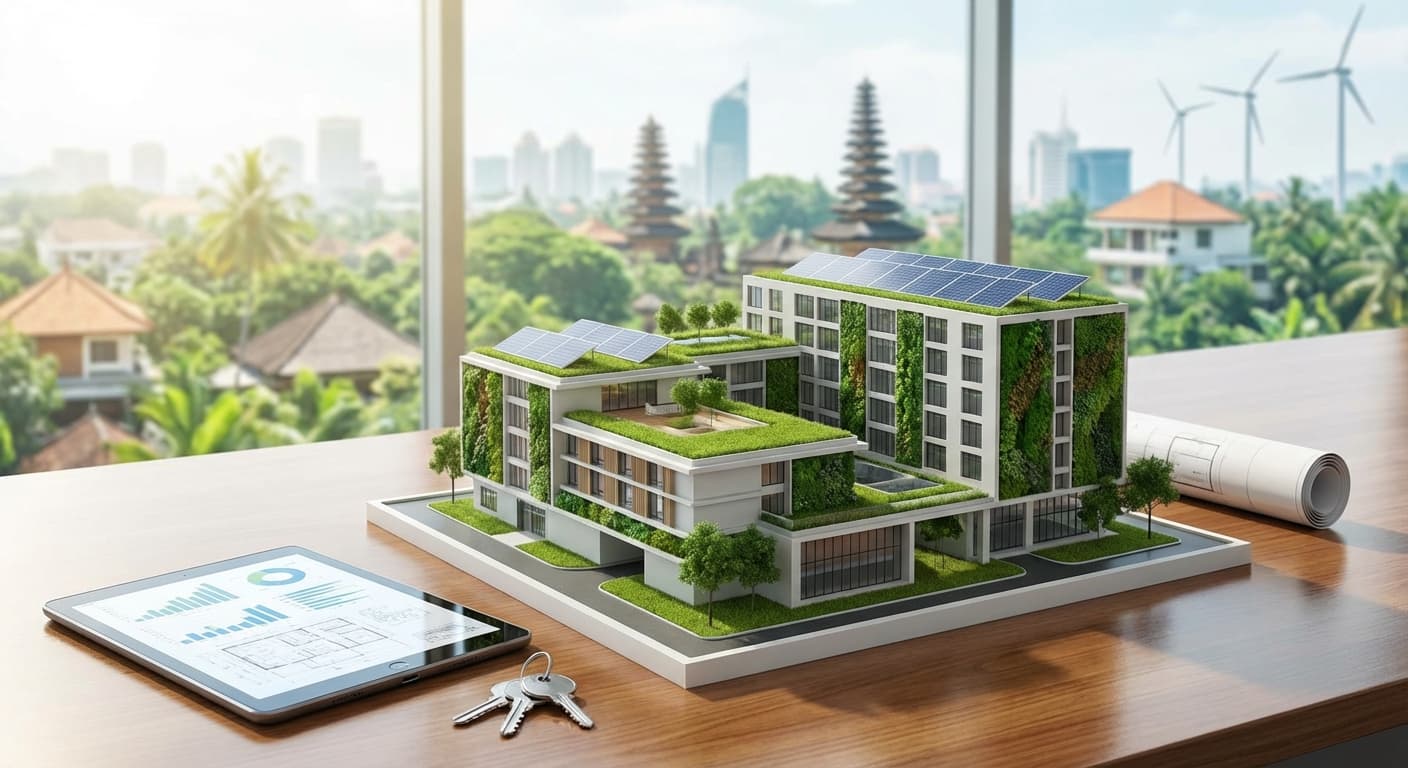
- Vertical gardens and rooftop gardens
- Smart home systems for energy efficiency
- Use of local and sustainable materials
- Integrated waste management systems
- Green areas and sky gardens
- Natural lighting and ventilation systems
- Charging stations for electric vehicles
- Water treatment plants for recycling water
- Sale values 15-20% higher than similar properties without certification
- Occupancy rates of 95% vs. 85% for conventional properties
- Rental yields 8-12% higher for commercial properties
- Electricity: 20-30% through LED lighting and efficient HVAC systems
- Water: 30-40% through recycling systems and water-saving fixtures
- Maintenance: 15-25% due to the use of high-quality materials
- Insurance: Some insurance companies offer discounts for green buildings
- Better indoor air quality
- Optimal natural lighting
- Lower noise levels
- More stable and comfortable temperatures
- Young professionals (25-40 years)
- Families with young children
- Companies with strong CSR programs
- Investors focused on sustainable investments
- "A home that is not only comfortable for your family but also for the planet."
- "An investment that benefits you and future generations."
- "An office that enhances productivity and employee health."
- Content marketing about green living
- Social media campaigns with the hashtag #EcoFriendlyProperty
- Webinars and virtual tours focusing on green features
- Collaborations with environmentally conscious influencers
- It is estimated that there will be over 1000 certified green buildings by 2030.
- Penetration into tier 2 cities like Medan, Makassar, and Palembang.
- The affordable housing segment will start adopting green building concepts.
- Smart buildings with AI for energy optimization.
- Building-integrated photovoltaics (BIPV).
- Air conditioning systems with inverter technology and IoT.
- Building materials made from recycled plastics and biomaterials.
- Possible mandatory green building requirements for projects above a certain size.
- Carbon taxes that will make green buildings more competitive.
- Increasingly stringent and comprehensive certification standards.
- Retrofitting existing properties to be more eco-friendly.
- Green building certification.
- Investment analysis for green properties.
- Sustainability reporting for corporate clients.
- Attend seminars and workshops on green building.
- Join the Green Building Council Indonesia (GBCI).
- Subscribe to newsletters and publications in the green building industry.
- Keep up with the latest technologies and materials.
- GREENSHIP Associate/Professional
- LEED Green Associate
- BREEAM Associate
- Sustainable Building Advisor
- Study the details of each green building feature.
- Prepare savings data and ROI calculations.
- Create comparison charts with conventional properties.
- Prepare case studies and testimonials.
- Use visual aids like infographics and videos.
- Bring an energy meter for real-time consumption demos.
- Invite clients for site visits to operational green buildings.
- Provide trial calculations for monthly savings.
- "Too expensive" → Show TCO and payback period.
- "Not sure about the technology" → Provide warranty information and track records.
- "Not familiar with the concept" → Educate in an easy-to-understand manner.
- Establish relationships with developers focused on green building.
- Attend launches and previews of green building projects.
- Request exclusive listings for eco-friendly properties.
- Join real estate agent communities.
- Network with architects and green building consultants.
- Collaborate with financial advisors for green financing.
Conclusion: A Bright Future for Eco-Friendly Properties
The trend of eco-friendly properties is not just a temporary phenomenon but a fundamental transformation of the Indonesian property industry. Data shows consistent growth and very optimistic projections for the coming years. For real estate agents who want to remain relevant and successful, understanding and mastering this segment is a strategic step that cannot be delayed.
The tangible financial benefits, government regulatory support, and increasing public awareness create a perfect storm for the exponential growth of eco-friendly properties. Agents who act quickly and position themselves as experts in this field will reap multiplied rewards.
Remember that selling eco-friendly properties is not just about business transactions but also a real contribution to a more sustainable future. Every green building property you successfully sell is a small step towards a greener and more sustainable Indonesia.
Call to Action: Start Your Journey Today
Ready to be a pioneer in the field of eco-friendly properties?
1. Start learning: Sign up for seminars or workshops on green building near you. 2. Build your network: Contact developers focused on sustainable development in your area. 3. Update your portfolio: Begin collecting quality eco-friendly property listings. 4. Invest in knowledge: Consider obtaining professional green building certification.
The future of the property industry is green, and your career as a real estate agent will be very bright if you prepare now. Don’t wait for your competitors to move first – take the first step today and become a leader in this highly promising eco-friendly property segment.
Remember: Every expert was once a beginner. What sets them apart is their willingness to start and consistently learn. Are you ready to become the next green property expert?